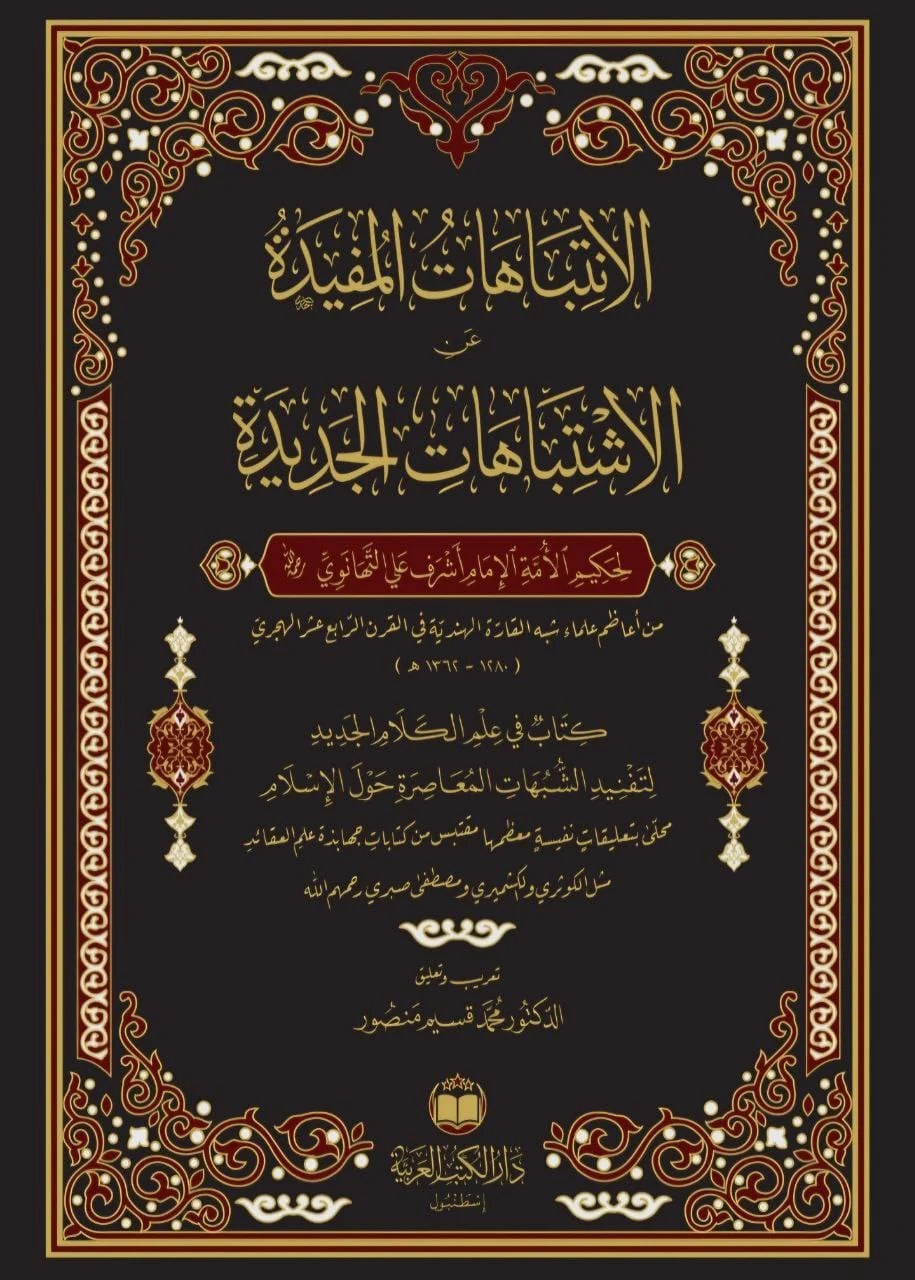
On Mawlānā Ashraf ʿAlī Thānawī’s al-Intibāhāt al-Mufīdah ʿan al-Ishtibāhāt al-Jadīdah and the new Arabic translation by Muḥammad Qasīm Manṣūr
By Guest Author
If you are a student of the Dars Niẓāmī, you have spent years picking up some serious intellectual tools: manṭiq, kalām, uṣūl al-fiqh, ʿulūm al-ḥadīth. You have worked through dense texts and learned to think carefully. What the books seldom give you, though, is the chance to actually use those tools on the questions that will greet you the moment you leave the madrasa. Mawlānā Ashraf ʿAlī Thānawī’s al-Intibāhāt al-Mufīdah ʿan al-Ishtibāhāt al-Jadīdah, roughly, “Beneficial Warnings on Modern Insecurities”, is that chance in book form. I cannot stress enough why every seminary student should read it, and ideally in a formal setting with a teacher.
The full title already tells you what kind of book this is. It is a pointed theological treatise deploying the full apparatus of classical Islamic dialectic against the intellectual pressures of colonial-era modernism. Yes, it was written a century ago. That matters less than you might think. The pseudo-rational objections that educated Muslims raise today are, underneath their contemporary dressing, the same objections Mawlānā Thānawī was already taking apart. The surface has changed but the philosophical structure has not.
What the Intibāhāt Was Responding To
In the nineteenth and early twentieth centuries, Muslim societies ran into something genuinely disorienting: a wave of intellectual prestige attached to empiricism and scientism that made core Islamic beliefs (in angels, in jinn, in divine decree, in the life after death) seem, to many educated Muslims, like embarrassing holdovers from a pre-scientific world. This was not the same old challenge of the Muʿtazila or the philosophers, the kind the tradition had already learned to handle. This was in some ways more corrosive: Muslims themselves internalizing an epistemological framework that only recognizes empirically verifiable claims as real knowledge.
The apologetics that followed often gave away far too much. Beliefs got quietly reinterpreted until they were barely recognizable, all in an effort to make Islam look respectable before a tribunal set up by the colonizer. Students at places like the Muhammedan Anglo-Oriental College in Aligarh were particularly caught up in this, and Mawlana Thānawī addresses some of his remarks in the book’s preface directly to that audience.
He also went after a more subtle error that was floating around: the idea that what Islam needs is a brand new ʿilm al-kalām, a theology rebuilt from scratch for the modern age, as though the classical apparatus were somehow past its sell-by date. The existing principles are comprehensive. The issue is not that the tools are old. The issue is that people stopped trusting them.
Seven Principles That Do All the Work
Here is where the book gets elegant. Mawlana Thānawī does not go objection by objection, one after another. That approach leads nowhere. You answer one challenge and another appears, and you are stuck playing defence indefinitely. Instead, he opens by establishing seven foundational epistemological principles drawn from classical Islamic logic and theology, and then shows how those principles, when properly applied, dissolve the entire family of modern objections in one move.
These principles deal with questions like: What is the relationship between reason and revelation? What epistemic weight does transmitted knowledge carry? What are the actual limits of empirical verification as a way of determining truth? Who bears the burden of proof when someone challenges a well-established religious position? Once those are settled on solid ground, the specific objections stop feeling overwhelming because you can see exactly where each one goes wrong.
Alongside all of this, Thānawī mounts a reasoned defence of the four sources of Islamic law: the Qurʾān, the Sunnah, ijmāʿ, and qiyās. This is not a detour. When you trace most modernist objections back far enough, they turn out to be objections to the authority of one or more of these sources. By defending their epistemic coherence together, he shows that Islamic epistemology is a unified, internally consistent system.
Why This Matters Specifically for Dars Niẓāmī Students
Institutions like Jāmiʿat Dār al-ʿUlūm Karachi have been wise enough to add this text to their curriculum, and it is not hard to see why their senior scholars made that call. The Dars Niẓāmī gives you rigorous training in the formal sciences. By the time you are done, you have studied logic, worked through kalām texts, and built up real conceptual vocabulary. What you often have not had is a demonstration of those tools actually in use on a real contemporary problem.
That is what reading al-Intibāhāt provides: you get to watch a classically trained mind (one of the finest of the last century) work through a live challenge using the tradition’s own methods, without apology and without unnecessary concession. When you go out and preach, teach, counsel, or simply sit with educated Muslims whose entire formation happened outside the madrasa, you need to be able to do something similar. You need to be able to show, with genuine confidence, that Islamic belief is not a collection of pre-rational commitments that somehow survived into the modern world. You need to demonstrate that the tradition has its own epistemology, coherent, serious, and philosophically defensible, and that it is actually the modernist demand for purely empirical verification that is the narrower and less examined position.
The New Arabic Translation
For a long time, if you could not read Urdu, this book was largely out of reach. There was an English abridgement, translated by the literary scholar Muḥammad Ḥasan Askarī and Karrār Ḥusain under the title Answer to Modernism, which opened it to one more audience. But the Arabic-reading world, which is a sizeable portion of the global seminary community, mostly missed out.
Muḥammad Qasīm Manṣūr’s new Arabic translation — the second one I am aware of — changes that. There is something fitting about it: Arabic is the native language of ʿilm al-kalām, the very tradition Thānawī is drawing on throughout, and returning his arguments to that language feels right. For students in the Arab world, in East Africa, in Western madrasas where Arabic is the medium of advanced instruction, and for Urdu-speaking students whose Arabic has quietly outpaced their Urdu reading ability — which is more common than people tend to admit — this translation makes the text genuinely accessible for the first time.
Read It Now, Not Later
There is a temptation to leave this kind of engagement until after graduation, as though wrestling with modernist challenges is a post-seminary problem. But the seven principles in this book come alive precisely when you are in the middle of the curriculum, when you are simultaneously working through logic texts, kalām, and uṣūl al-fiqh. Everything reads differently when you can see what it is actually for in practice.
The book is not long. It will not take months. What it asks for is not so much time as genuine seriousness, a willingness to follow the author’s tight, methodical reasoning as he reconstructs, from first principles, how the Islamic tradition understands what it knows and why. Do not wait for a teacher to put it on a reading list. Find it, sit with it, and read it again when you are done with your studies. You will be surprised how much more you see the second time around.