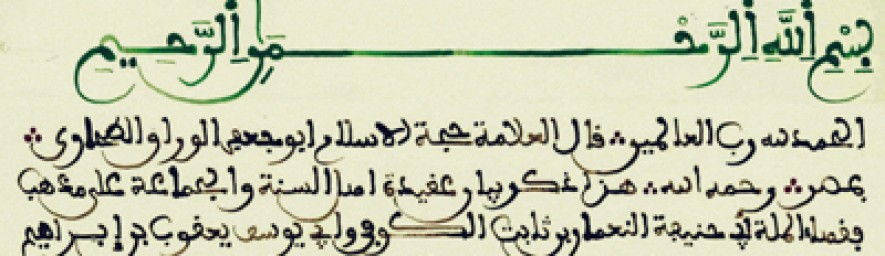
Translation of the Chapter on Raf’ al-Yadayn from I’la’ al-Sunan

Chapter on Not Raising the Hands in other than the Opening & the Command to be Still in Salah

By ‘Allamah Zafar Ahmad al-‘Uthmani

Translated by Zameelur Rahman

1. Narrated from Tamim ibn Tarafah from Jabir ibn Samurah (Allah be pleased with him): He said:

Allah‟s Messenger (Allah bless him and grant him peace) came out to us and said: “Why do I see you raising your hands like they are the tails of wild horses? Be still in Salah!” Muslim narrated it (1:181).

I say: The evidence adhered to in this hadith is his (Allah bless him and grant him peace) statement, “Be still in Salah,” as it proves the obligation of stillness and that raising the hands in Salah negates this [stillness].

If it is said that his (Allah bless him and grant him peace) statement, “Why do I see you raising your hands like they are the tails of wild horses?” was said specifically with respect to raising [the hands] upon salam as clarified in a second hadith, which is Muslim’s narration from ‘Ubayd Allah ibn al-Qibtiyyah from Jabir ibn Samurah, he said: “We would, when praying with Allah’s Messenger (Allah bless him and grant him), say ‘al-salamu ‘alaykum wa rahmat Allah, al-salamu ‘alaykum wa rahmat Allah,’” and he gestured with his hands to the side, “so Allah’s Messenger (Allah bless him and grant him peace) said: ‘Why do you gesture with your hands like they are the tails of wild horses?’”

Translation of I’la al-Sunan Section on Raf’ al-Yadayn

Translation of the Introduction to I’la’ al-Sunan by Mufti Muhammad Taqi Usmani

This wonderful introduction succinctly discusses the biographies of Imam Ashraf ‘Ali al-Thanawi and Imam Zafar Ahmad al-Thanawi as well as an introduction to the renowned work: I’la’ al-Sunan.

The translation has been done by our dear friend and regular contributor, Zameelur Rahman, along with a translation of a chapter of the book that will be uploaded at a later time, iA.

We are pleased to be the first to present this translation to the public and ask that everyone keep the translator in their prayers, specifically for the continuation of his contributions. Amin.

-Bilal Ali

Introduction to I’la al-Sunan – Mufti Taqi Uthmani

Translation of Mawlana Habib Ahmad al-Kiranawi’s Al-Din al-Qayyim, Part of the Introduction to I’la’ al-Sunan

at-Tahawi.com is pleased to announce the online release of Mawlana Habib Ahmad al-Kiranawi’s al-Din al-Qayyim, a treatise on taqlid and ijtihad and a detailed refutation of Imam Ibn al-Qayyim’s views on taqlid. The treatise is included in the introduction to Imam Zafar Ahmad al-‘Uthmani’s monumental and renowned work, I’la’ al-Sunan, a collection of over six thousand hadith proofs in support of the Hanafi legal arguments.

The translator of the work, our dear brother Zameelur Rahman, may Allah increase him in barakah, was gracious enough to share the pdf of the book with us and offer it for free download. Please do include him in your du’as, especially during these special days. We have included a portion of his preface to the work below:


Translator’s Preface

In Allah’s Name, the Infinitely Merciful, the Beneficent. All praise to Allah, Lord of the Worlds. May blessings and peace shower on His final Messenger, Muhammad, his family and his companions.

This book is a translation of the treatise al-Din al-Qayyim by the late Indian scholar, Mawlana Habib Ahmad al-Kiranawi, published with a number of his other writings under the title Fawa’id fi ‘Ulum al- Fiqh. Al-Din al-Qayyim was written as a detailed refutation of Shaykh Ibn Qayyim al-Jawziyyah’s (691 H/1292 CE – 751 H/1349 CE) arguments against taqlid from his I’lam al-Muwaqqi’in which offers the most thorough denunciation of taqlid and its proofs to date. The refutation was written in Arabic by Mawlana Habib Ahmad under the supervision of Hakim al-Ummah Mawlana Ashraf ‘Ali al-Thanawi (d. 1362 H/ 1943 AD) as part of the general introduction to the 20-volume compendium of hadith- proofs for the Hanafi madhhab, I’la al-Sunan.*

Mawlana Habib Ahmad in a rigorous and precise manner shows not only that taqlid, which is the non- mujtahid’s deference to a mujtahid Imam in rulings of the Shari’ah without asking for detailed proofs, is established from the Qur‟an, Sunnah and the practice of the Salaf, but that it is so fundamental and necessary for Islamic scholarship and practice to function at any level that its detractors have no option but to resort to taqlid, while repackaging it as “adherence to proof.” It is a must-read for anyone wishing to understand the structure of Islamic scholarship and the weakness of the arguments presented by those who wish to deny the legitimacy and necessity of taqlid.

Download al-Din al-Qayyim

Review of Abu Hanifa: His Life, Legal Method and Legacy by Shaykh Akram Nadwi

Reproduced here with kind permission from Muslim World Book Review (MWBR)

Review: Abu Hanifa: His Life, Legal Method and Legacy

Mohammad Akram Nadwi, (Markfield: Kube Publishing Ltd., 2010)

Reviewed by: Dr M Mansur Ali

Cardiff University

Muslim World Book Review (MWBR) vol. 31, no. 4, Summer 2011, pp. 29-31.

This very short, albeit highly erudite work of hagiography has been written by a scholar who has engaged with Abu Hanifa and his legacy for a very long time. By using only the most authentic reports found in the classical Islamic prosopographical collections, original Arabic and Urdu sources and core Hanafi legal texts, the author endeavours to understand ‘why’ and ‘how’ Abu Hanifa came to inherit the appellation ‘Al-Imam al-A’zam’ (the greatest one worthy to be followed), an epithet which is worthy of him today as it was in his days.

The book is written in the typical format of a classical Islamic biography work. He discusses, Abu Hanifa’s life, his life style, his erudition and probity, his piety and propriety, his scholarship, his teachers and his students. He talks about him as a jurist, a lawyer, a theologian and a Hadith scholar. The impact of Abu Hanifa’s fiqh and its status in the modern age is discussed in details. All of these discussions take place within the framework of the overall development of Islamic law in general. The quality of the book is further enhanced by the use of diagrams and an annotated reading list. At this juncture, given the plethora of sources found on Abu Hanifa’s life in English in the form of monographs, articles, introductory sections to translated classical texts, translations of Arabic and Urdu books, audio and visual recordings and the internet, the question that looms on this reviewer’s mind is ‘what is the need for yet another biography of Abu Hanifa?’

The reviewer believes that it is what the author wants to do with the biography of Abu Hanifa that justifies the writing of this book. The author deems it pertinent to write this book because of three reasons. Firstly, he takes issues with the many voices from within and outwith Islam shouting for an Islamic reformation. He argues that Islam’s contribution to the modern world especially in trade and commerce has been advanced by people like Abu Hanifa and his ilk. It’s only through understanding and emulating the lives of these pious savants that some of the ethical and moral principles that have been lost can be restored. Secondly, information readily available through high-speed medium is not ‘ilm but short lived, bereft of any substance and missing the personal touch of a wise master. Through this book, the author wants to remind us that true ‘ilm can only be sought through slow and painstaking study where the knowledge is passed from heart to heart.

For this reviewer, the most unique contribution of this book is the author’s third reason for writing the book. The author draws a distinction between Abu Hanifa and later Hanafi scholars. That Abu Hanifa is someone who understood the context as well as the text, that he made a distinction between the spirit of the law and its word and that his understanding of the law is not partial but holistic. He urges Muslim scholars to recover both their intellectual ability as well as their moral authority to understand the Qur,an and Sunna in its entirety and not just in parts. The scholars will find a precedent for this in Abu Hanifa, who paradoxically, was neither a Hanafi nor a professional Hanafi Mufti. This is a streak that one can implicitly see throughout the work (pp. 115-120). The author very subtly tries to rescue Abu Hanifa from Hanafi scholars who are engaged in ‘self-contained discourse’, where the fiqh is presented ‘with reference to itself rather than its sources’, a partial and anachronistic understanding of fiqh that is severed from reality.

Equally unique is the author’s discussion on the development of the sciences of Hadith. One of the major drawbacks, that this reviewer has noticed, in some traditional Islamic circles is that people tend to treat the works of the scholars in a way as if they were all written in the same era; working with the same hermeneutical devices and employing terminologies that are ossified in time. This kind of attitude towards the sources leads to misunderstanding and unfounded criticism as the author has shown. Abu Hanifa cannot be blamed for following a hadith deemed to be weak by later standards if those standards were not available in his day and age. If the Hanafi School is founded upon those standards used by Abu Hanifa, then it is not fair to judge the actions of its followers through later developments. This is a very important subject as it will put a lot of minds at ease as to why seemingly Abu Hanifa does not follow sound Hadith.

A few personal observations. One does not get an inkling of the author’s opinion regarding the authorship of Al-Fiqh Al-Akbar. Abu Zahra opines that some of the topics discussed in the work seem to have developed after Abu Hanifa. It would have been interesting to see how the author reacts to this assertion. The author very brilliantly sheds light on Abu Hanifa as a Hadith scholar. However, this discussion would have been further enhanced if the author addressed the common cliché that Abu Hanifa knew only 17 Hadiths. An assumption that stems from a comment made by Ibn Khaldun in his Prolegomena (although Ibn Khaldun does indicate it to be a weak claim by using the passive perfective verb ‘qeela’). A section on the Hadith works of the school would have nicely complimented the legacy of Abu Hanifa. Finally, ‘Radd al-Mukhtar’ should read ‘Radd al-Muhtar’ (p. 111).

The author has successfully delivered his promise to understand as to ‘why’ and ‘how’ Abu Hanifa came to deserve the title ‘Al-Imam al-A’zam’; it now remains the duty of the scholars to imbibe Abu Hanifa’s teachings in trying to understand the Qur’an and Sunna holistically in both letter and spirit.