A short Urdu biography of Khwaja Khan Muhammad رحمه الله تعالى
by Mawlana Shaykh Rasheed al-Haq Khan Abid.
A short Urdu biography of Khwaja Khan Muhammad رحمه الله تعالى
by Mawlana Shaykh Rasheed al-Haq Khan Abid.
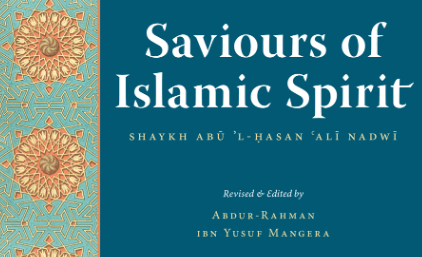
The much anticipated revised English translation of Saviours of Islamic Spirit (Tarikh-i Da’wat wa Azimat) by Shaykh Abu ‘l-Hasan Ali al-Nadwi (ra) has been released by White Thread Press.
The work was originally rendered into English by the late Mohiuddin Ahmad (may Allah have mercy upon his soul), who has also translated other works of Shaykh Nadwi (ra). The initial publication of that translation was released by the Academy of Islamic Research & Publications (Lucknow, India). A later publication of the same translation – without editing – was done by Darul Ishaat (Karachi, Pakistan). May Allah (SWT) reward them as they were the only conduits through which this highly regarded work was available to the English-speaking audience.
Notwithstanding, some of the language in the translation had become archaic. Also, the original publication’s quality was in much need of revamping in regards to the typesetting, print, paper quality, binding, cover, etc. White Thread Press embarked upon this project some time back, and we had been eagerly awaiting news of its progress.
All praise belongs to Allah (SWT) who brought the project to fruition. Mufti Abdur-Rahman Ibn Yusuf Mangera (may Allah bless and accept him) revised and edited the work, and it has now been released by White Thread Press.
Currently, only the 1st volume is published and available. We pray and hope that WTP continues to pursue the editing and publishing of the remainder volumes to complete the entire series (containing the biographies of Ibn Taymiyya, Nizāmuddin Awliya, Mujaddid Alf-Thāni, Shah Walīullah, Syed Ahmad Shahīd, and more).
Pages: 282
Format: Softcover
Dimensions: 6″ x 9″
ISBN: 978-1-93-376413-9
asSalaamu Alaikum,
Author: Shaykh Mohammad Akram Nadwi
Format: Paperback
Pages: 314
ISBN: 978-0957402904
About The Book
Shaykh ’Abū al-Hasan ‘Alī Nadwī (1914-1999/1332-1419 AH), one of the most widely read and influential scholars of our time, was likened by his intellectual peers to the exemplary scholars of the earliest generations of Islam. His writings have been translated from Arabic or Urdu into all of the major languages of the world and remain popular from one generation to the next. In this account by a former student, various aspects of Shaykh ’Abū al-Hasan’s life and works are presented – his education and upbringing, his role as a leader and guide, his writings, and his da‘wah and tarbiyah (calling people to Islam and training others to do so). This biography sets out his response to groups and movements that did not share his distinctive approach to issues of concern to Muslims. The unifying theme of the book is Shaykh Nadwī’s timeless commitment, as a scholar and dā‘ī, to the spiritual well-being of Muslims, emphasising their relationship with God and each other, and their response to Western cultural influences.
About the Author
MOḤAMMAD ʾAKRAM NADWI is one of the UK’s best-known scholars with a classical training in the Islamic religious sciences. He studied, and later taught, at the renowned Dār al-ʿUlūm Nadwat al-ʿUlamāʾ in Lucknow, India, and holds a doctorate from the University of Lucknow. Currently a Research Fellow at the Oxford Centre for Islamic Studies, he is also the author of over 25 books on a range of subjects including Ḥadīth, Fiqh, Arabic grammar and Islamic biographies, published in Arabic, English and Urdu. His magnum opus is a forty-volume compilation of biographies of women scholars of Ḥadīth; the introduction to this study was translated into English and published as al-Muḥaddithāt: The Women Scholars in Islam (2007). His more recent titles include ʾAbū Ḥanīfah: His Life, Legal Method and Legacy (2010) and the second volume of al–Fiqh al–ʾIslāmī: Zakāh, Ṣawm and Ḥajj (2012).
asSalaamu Alaikum
Download: Imams of the Valley by Amin Buxton
The valley of Hadramawt is situated in Yemen, in the south of the Arabian Peninsular.Since members of the blessed Prophetic household settled in the Valley in the fourth century of the Hijrah, it has been a centre of sacred knowledge and the attainment of spiritual perfection. In this remote valley, and particularly in its spiritual capital, Tarim, the Prophetic legacy was preserved and nurtured and then carried to the far cor- ners of the earth.
Beginning with the first of the descendants of the Prophet sallaLlahu alayhi wasallam to settle in Hadramawt and looking down the centuries to recent times, “Imams of the Valley” examines the lives of a few of these illustrious figures. It is hoped that this book will enable the reader to increase in love for the family of the Messenger sallaLlahu alayhi wasallam and for the pious, which is one of the foundations of Islam.
Size: 152mm x 222mm
Pages: 136
Foreword
All praise is due to Allah, Whose bounty is limitless, and peace and blessings be upon His Beloved Muhammad and upon his pure family, noble Companions and all those who follow their path until the Last Day. Love for the family of the Messenger sallaLlahu alayhi wasallam and the pious members of his Ummah is one of the foundations of this religion but attainment of this love requires knowledge. The following pages are an attempt to acquaint the English speaker with some of the greatest Imams of the ‘Alawi Way, who made the Valley of Hadramawt their home. It is hoped that this acquaintance will lead to love for them and attachment to them, and be of the utmost benefit in this life and the next. The way of these Imams was to prefer obscurity and they are probably better known in the Heavenly realm than on this Earth. However, there is a need for us to come to know them.
Volumes could not do justice to any of the Imams mentioned here and words cannot express the stations which they reached. However, it is hoped that such an introduction can be a door leading to greater things.
Some of the teachers and pupils of each Imam are mentioned to illustrate the importance of the concept of sanad, the unbroken chain which connects Imam to Imam and preserves the purity and authenticity of the knowledge which they transmit. Dates are generally given in the Hijri calendar, although some corresponding dates are given.
We thank Allah for the presence of those who embody the way of these great Imams in the times in which we live. At their forefront is sayyidi Habib ‘Umar bin Hafiz and Habib Abu Bakr bin ‘Ali al-Mashhur, who represent the final link in this amazing chain. We have recently lost the physical presence of Habib “Sa`d” al-`Aydarus but his memory lives on. May Allah reward Shaykh Munir Ba Zuhayr, who, along with the forementioned, was the inspiration for this work. May Allah also reward Shaykh Abdurragman Khan and Shaykh Riyad Saloojee for their assistance. May Allah preserve them and increase them.
Courtesy of Dar al-Turath al-Islami
asSalaamu Alaikum,
Sirat ibn Hisham – Abridged English Translation
Abridgment done by Abdus-Salam M. Harun. He writes in the Introduction:
In this ‘abridgment’, l tried to extract elements from the original work to present it in a new form that is allowed for uninterrupted reading, while being careful about the original text so the reader could cite it. I did not replace a letter of the original text so as to be honest in performance. I referred to Ibn Hisham’s wordings in the beginning of the subject or in footnotes, but the whole text is of Ibn Ishaq as narrated by Ibn Hisham.
I mentioned the chain of authorities only when it was indispensable for the subject by quoting what had been reported by Ibn Ishaq or Ibn Hisham. To make the text coherent I interpreted what was needed of explanation, relying on accredited Sirah commentaries and linguistic references.
Abridgement is a kind of facilitation for those who are unable to read the original and it serves to link today’s youth to their heritage. Allah willing, you would be able to read this book in a few days and acquire an immediate benefit, while reading the original, if possible, would take a few months.