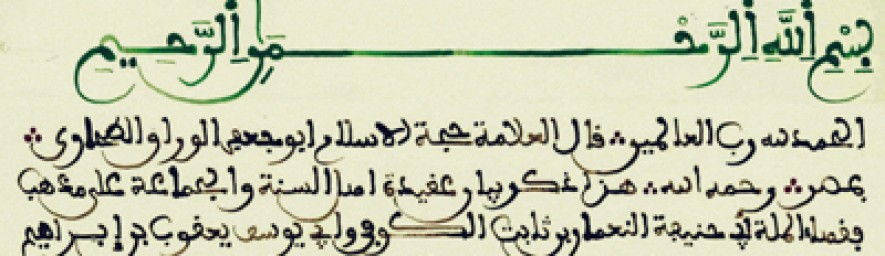
I’rab al-Qur’an al-Karim by Shaykh Muhyi ‘l-Din Darwish

I'rab al-Qur'an al-KarimRecently, a number of students who study Arabic syntax with me asked for my recommendation on a good book that focused on the i’rab of the Qur’an (grammatical analysis of each ayah).

While I admitted that I was not familiar with all the new works that have been published recently on the topic, and having already suggested reading Zamakhshari’s Kashshaf, I mentioned that while I was a student the only book of the type that I ever had a chance to use was Shaykh Muhyi ‘l-Din Darwish’s voluminous I’rab al-Qur’an al-Karim.

I humbly request anyone who has read other books on i’rab al-Qur’an to post their comments, suggestions, and reviews. Below, I have posted the pdf of Darwish’s book.

I’rab al-Qur’an al-Karim_Darwish

Mukhtasar Khilafiyat al-Bayhaqi

Mukhtasar Khilafiyat BayhaqiBrother ashrafh, aka Hasan Ashraf, was kind enough to share with us an important book of comparitive fiqh that argues the Shafi’i stance on legal issues, highlighting the legal contentions that existed between the Shafi’i and the Hanafi (or as Imam Bayhaqi terms it, the “Iraqi”) schools.

The book that brother Hasan provided is an abridged form of Imam Bayhaqi’s (384-458 AH) original work, entitled al-Khilafiyat, which is also available in pdf format and has been uploaded here as well for those who are interested. Unfortunately, however, the original book has not been published in its entirety and only the Book of Purification has been published so far, albeit in three large volumes. I have heard that the muhaqqiq has completed the tahqiq on the rest of the book, but I cannot confirm this. I cannot be sure that the entire book is even available in manuscript form, although I have not read otherwise.

The abridged book, entitled Mukhtasar Khilafiyat al-Bayhaqi, is the work of Imam Ahmad ibn Farah al-Lakhmi al-Ishbili (d. 699AH), and due to the extensive notes on the differences in manuscripts and hadith referencing, the abridged version covers five volumes. The book is a must for all students of the Shafi’i madhhab, particularly those who are interested in the early legal argumentation that took place between these two major schools of fiqh.

For a similar work by a scholar contemporary to Imam Bayhaqi and from the opposite viewpoint, one should read Imam Quduri’s (362-428 AH) al-Tajrid, recently published under the name al-Mawsu’ah al-Fiqhiyyah al-Muqaranah: al-Tajrid. This book, like Imam Bayhaqi’s al-Khilafiyat, is a much neglected reference amongst students of the Hanafi school. I have provided a link to the tenth volume of Imam Quduri’s voluminous work as a sample. I don’t think the rest of the book has yet been scanned and posted online. In sha Allah, I hope to write up a separate post and review of al-Tajrid in the future.

Mukhtasar Khilafiyat al-Bayhaqi 1

Mukhtasar Khilafiyat al-Bayhaqi 2

Mukhtasar Khilafiyat al-Bayhaqi 3

Mukhtasar Khilafiyat al-Bayhaqi 4

Mukhtasar Khilafiyat al-Bayhaqi 5

الخلافيات للبيهقي 1

الخلافيات للبيهقي 2

الخلافيات للبيهقي 3

al-Mawsu’ah al-Fiqhiyyah al-Muqaranah: al-Tajrid

Shabe Barat: The Fifteenth of Shabaan in the Light of the Qur’an and Hadeeth by Shaykh Fazlur Rahman ‘Azmi

Shabe BaratGiven that the fifteenth of Sha’ban is upon us, the usual questions about the signigicance of the night of the 15th and fasting on its day have begun to come up. I thought it would be useful to read a researched answer by one of today’s foremost authorities in the science of Hadith, Shaykh al-Hadith Mawlana Fadl al-Rahman al-A’zami (Fazlur Rahman ‘Azmi), on the subject.

Shabe Baraat: The Fifteenth of Shabaan in the Light of the Qur’an and Hadeeth

al-Kitab al-Asasi: Teaching Arabic to Non-Native Speakers

Assalamu ‘alaykum,

Recently, a student and I were discussing his Arabic studies and how he benefited more from visual learning. Being able to picture the vocabulary he was expected to memorize was aiding him immensely in picking up the words at a quicker pace.

Although books like Lisan al-Qur’an, Arabic Tutor, and the Durus al-Lughah Madinah Book series are useful for both grammar and vocabulary for non-native speakers of the language, none of them are as simple and visually helpful as the famous al-Kitab al-Asasi. Although it is important to keep in mind that these books are all meant for students at different levels of study, it is common to see beginners start with books that make it difficult starting off. A book like al-Kitab al-Asasi helps many students in the West gradually progress through the Arabic letters and basic grammar.

I have found that this book is especially useful for new Muslims who are not familiar with any language that uses the Arabic letters or Arabic words, such as Urdu or Farsi. A pdf of the first volume of the book has been uploaded onto the site below.

al-Kitab al-Asasi

Summer Suggested Reading List of English Books

At the request of some students and friends, I decided to come up with a list of books that I would suggest them to read this summer. Since the query was regarding English books, I have confined my list accordingly. Understanding that most students will read on average no more than four to five books in the coming summer months, I have listed only five books at the moment. Admittedly, not all of these books are on purely “Islamic” topics, but they are all certainly Islamic in nature and are highly beneficial.

My Summer Suggested Reading List of English Books

road to makkah1. The Road to Makkah

Muslim statesman and scholar Muhammad Asad tells the story of his road to discovery of Islam and his travels in Muslim lands, including those to Palestine, TransJordan, Arabia, North Africa, Turkey, and Persia, with the Saud family, with the Shah of Iran, and his own spiritual journey.

An important book on Islam and its place in modern society. Indian print does not include the photographs that are in the UK print.

The Road to Makkah is not just a travelogue one picks up to read about the conditions of the people and landscape of country in the distant past; it is an absorbing personal saga of man’s ‘home-coming’ to Islam, the religion of his fitrah (nature).

7-habits2. 7 Habits of Highly Effective People

The 7 Habits of Highly Effective People: Powerful Lessons in Personal Change was a groundbreaker when it was first published in 1990, and it continues to be a business bestseller with more than 10 million copies sold. Stephen Covey, an internationally respected leadership authority, realizes that true success encompasses a balance of personal and professional effectiveness, so this book is a manual for performing better in both arenas. His anecdotes are as frequently from family situations as from business challenges.

Before you can adopt the seven habits, you’ll need to accomplish what Covey calls a “paradigm shift”–a change in perception and interpretation of how the world works. Covey takes you through this change, which affects how you perceive and act regarding productivity, time management, positive thinking, developing your “proactive muscles” (acting with initiative rather than reacting), and much more.

This isn’t a quick-tips-start-tomorrow kind of book. The concepts are sometimes intricate, and you’ll want to study this book, not skim it. When you finish, you’ll probably have Post-it notes or hand-written annotations in every chapter, and you’ll feel like you’ve taken a powerful seminar by Covey. –Joan Price

Review
John Pepper President, Procter and Gamble I’ve never known any teacher or mentor on improving personal effectiveness to generate such an overwhelmingly positive reaction….This book captures beautifully Stephen’s philosophy of principles. I think anyone reading it will quickly understand the enormous reaction I and others have had to Dr. Covey’s teachings. — Review

Economic Hit Man3. Confessions of an Economic Hit Man

Amazon.com Review
John Perkins started and stopped writing Confessions of an Economic Hit Man four times over 20 years. He says he was threatened and bribed in an effort to kill the project, but after 9/11 he finally decided to go through with this expose of his former professional life. Perkins, a former chief economist at Boston strategic-consulting firm Chas. T. Main, says he was an “economic hit man” for 10 years, helping U.S. intelligence agencies and multinationals cajole and blackmail foreign leaders into serving U.S. foreign policy and awarding lucrative contracts to American business. “Economic hit men (EHMs) are highly paid professionals who cheat countries around the globe out of trillions of dollars,” Perkins writes. Confessions of an Economic Hit Man is an extraordinary and gripping tale of intrigue and dark machinations. Think John Le Carré, except it’s a true story.

Perkins writes that his economic projections cooked the books Enron-style to convince foreign governments to accept billions of dollars of loans from the World Bank and other institutions to build dams, airports, electric grids, and other infrastructure he knew they couldn’t afford. The loans were given on condition that construction and engineering contracts went to U.S. companies. Often, the money would simply be transferred from one bank account in Washington, D.C., to another one in New York or San Francisco. The deals were smoothed over with bribes for foreign officials, but it was the taxpayers in the foreign countries who had to pay back the loans. When their governments couldn’t do so, as was often the case, the U.S. or its henchmen at the World Bank or International Monetary Fund would step in and essentially place the country in trusteeship, dictating everything from its spending budget to security agreements and even its United Nations votes. It was, Perkins writes, a clever way for the U.S. to expand its “empire” at the expense of Third World citizens. While at times he seems a little overly focused on conspiracies, perhaps that’s not surprising considering the life he’s led. –Alex Roslin

ShaykhalHadithFazlurRahman4. Shaykh al-Hadith Fazlur Rahman Azmi

A Brief Biography Of Shaykh al-Hadith Fazlur Rahman Azmi.

Biographies tend to surface after the death of a notable individual. The mere fact that this biography is before you in the lifetime of its subject- Shaykh Fazlur Rahman Azmi, is an indication of the acceptance with which he has been bestowed. This book will provide the reader with a glimpse of one of the great contemporary scholars of Islam and a leading authority of hadith. Furthermore, it is hoped that this brief work will serve as an inspiration to all: with effort, sacrifice and devotion to Allah, a great deal can be achieved.

Shaykh al-Hadith Fazlur Rahman Azmi (b.1356/1946) has been teaching the Islamic sciences since 1390/1971. He has been teaching Sahih al-Bukhari, Sunan al-Tirmidhi, Mishkat al-Masabih and other major books at Madrasah Arabia Islamia, Azaadville (South Africa) since 1406/1986. He is a prolific writer and has authored over forty books. His most famous works include introductions to Sahih al-Bukhari and Sunan al-Tirmidhi. He has also been active in the field of da’wa and tabligh and has benefited many as a distinguished disiple of Shah Hakim Muhammad Akhtar in the field of spiritual reformation (tazkiya).

Praise from distinguished scholars …

‘His mere presence is a great bounty for the people of South Africa.’ – Shaykh Marghub Ahmad Lajpuri

Hold firmly to him … firstly, because of his faith (iman), then because of his love of the Prophet (peace and blessings upon him), then because of his knowledge.’ – Shaykh Zuhayr Ibn Nasir al-Nasir (al-Madinah al-Munawwarah, Saudi Arabia)

‘…of whom the term ”mountain of knowledge” is most appropriate.’ – Mufti Muhammad Faruq Mirathi

Saviours New5. Saviours of Islamic Spirit

A translation of Nadwi’s Tarikhe Da’wat wa Azimat

This book contains biographies of some of the most influential personalities of Islam after the beloved Companions (may Allah be pleased with them): Umar Ibn Abd al-Aziz, Hasan Basri, Nur al-Din Zangi, Salah al-Din Ayyubi, Imam Ghazali, Abdul Qadir Jilani, Ibn al-Jawzi, and ‘Allama Jalal al-Din Rumi among others. According to a scholar who read this book at a later stage in life, he said, “Had I read this book earlier on in life (in youth) I would have had a different perspective of life, and it would have made more sense.”

Mawlana Abul Hasan Ali Nadwi, himself one of the greats of his time, accomplished the exceptional task of writing the history of Islam through the lives of its great men.  The first of these personalities is the caliph of Umar ibn Abdul Aziz and covers biographies up to Mujaddid Alf Thani.  The 1st volume covers the revivalists endeavours during the first six centuries of hijrah and the 2nd volume presents luminaries of the eight century after hijrah, and the 2rd volume includes the life of Mujaddid Alf Thani, and the famous men of India.

A very comprehensive book where through the luminaries of Islam, a history of Islam is presented up to the first few centuries.  Lives, achievements, thoughts and circumstances of these great men are the subject mater of these three volumes.

Each volume has its own detailed index and bibliography, chronological table and glossary are included in the first two volumes.